Dental cloud practice management software runs your clinic’s records, schedule, charting, billing, and claims from a browser instead of a server sitting in your back office. UAE clinics face a specific version of this decision. Mandatory health insurance across all seven emirates since 1 January 2025 pushed claim volume into private practices, while NABIDH, Malaffi, and Riayati integration turned software selection into a licensing matter. This guide covers architecture, compliance, pricing, migration, and the exact questions to ask a vendor before signing, with reference points from Yolo, a German-engineered clinic management platform built for the UAE market.
What Is Dental Cloud Practice Management Software?
Dental cloud practice management software centralises patient records, appointments, clinical charting, imaging, billing, and reporting inside a multi-tenant SaaS platform accessed through any browser. No local server. No hardware refresh cycle.
How it differs from legacy server-based systems
Legacy systems bind your clinic to a physical machine in a locked cupboard. That machine holds the database, runs the backups, and fails on a Thursday afternoon.
Server-based architecture creates three operational costs that never appear on the invoice:
- IT dependency: every update, patch, and restore requires a technician on site
- Location lock: records stay inside the building, so a second branch means a second database
- Recovery risk: backup validation falls to clinic staff who were never trained for it
Cloud-native architecture strips all three. Yolo ships as a no-hardware deployment, so the vendor patches, backs up, and scales without touching your premises.
Uptime SLA becomes your contract, not your problem.
Dental PMS vs. a general clinic management system
Dental-specific platforms build around periodontal charting, tooth-surface notation, and CDT codes. A multi-specialty centre with a dental wing alongside dermatology and physiotherapy often gains more from a unified cloud clinic management system covering EMR, scheduling, inventory, payroll, and accounting across every department, rather than running a separate electronic dental record in parallel and reconciling two databases at month end.
The decision reduces to one question: is dentistry your entire operation, or one department inside it? Answering it means knowing what the wider category covers first, because what is a clinic management system is a question of scope, EMR, scheduling, inventory, payroll, and accounting running across every department, rather than one specialty’s chart deepened.
Yolo sits in the second category. The platform serves dental, dermatology, physiotherapy, orthopedics, gynecology, internal medicine, cardiology, oncology, and andrology practices from one system, which suits polyclinics and small chains running mixed specialties.
Why UAE clinics are migrating now
Regulatory pressure drives the timing. Health information exchange participation is a condition of licensing, and integration happens through your software vendor via HL7 v2.5.1, with FHIR R4 used for newer work.
Three forces converged:
- Mandatory insurance from January 2025 raised claim volume per clinic
- Dubai directive PD-05-2025 mandated end-to-end electronic claims through eClaimLink with fixed pre-authorization and payment timelines
- HIE connectivity moved from optional to licence-critical across DHA, DoH Abu Dhabi, and MOHAP jurisdictions
A server in your back office cannot satisfy any of the three on its own.
What “cloud-native” actually means (and what it does not)
Cloud-native describes software designed for shared infrastructure from the first line of code. Hosted is not the same thing.
| Model | What it actually is | Multi-branch reporting |
| Cloud-native | Multi-tenant SaaS, browser-based, one shared codebase | Native and real time |
| Hosted legacy | Old server software running on a rented virtual machine | Usually one database per site |
| Hybrid | Local server plus cloud sync layer | Depends on the sync design |
Vendors market the middle row as cloud. Read the architecture answer, not the label.
Architecture determines what your reporting can and cannot do, which is where the next decision sits.
Cloud vs. On-Premise: The Architecture Decision Behind the Software Choice
Architecture decides whether cross-location reporting takes minutes or weeks. Dental cloud practice management software centralises the database by default, while on-premise systems create one isolated database per location, and that difference compounds with every branch you open.
One database per branch vs. a single centralised record
Centralised database design gives a patient one record across every site. Front desk in Dubai Marina sees the same chart as Sharjah.
Server-based groups face the opposite reality:
- Duplicate patient files across branches
- Manual exports to build a group-level revenue report
- No live view of chair utilisation across sites
- Referrals between branches handled by phone and email
Cross-location reporting stops being a feature request and becomes a structural property of the system.
Backup, downtime, and business-continuity implications
Backup frequency separates a two-hour incident from a two-week reconstruction. Cloud vendors run automated backups on a defined schedule with tested restore paths.
On-premise backup depends on whoever remembered to change the drive.
Ask any vendor for two numbers: recovery point objective and recovery time objective. Those two figures tell you how much data you lose and how long you wait.
Internet dependency and offline failover realities
Internet dependency is the honest trade-off of any browser-based system. Cloud software stops when connectivity stops.
Practical mitigation looks like this:
- Install a second connection from a different provider
- Configure automatic failover to 4G or 5G mobile data
- Keep a printed day-sheet of the schedule as a manual fallback
- Confirm the platform caches the active session rather than dropping it
Yolo runs as a web app plus native iOS, Android, and Huawei applications, so a device switch during an outage keeps the schedule accessible.
Hybrid and self-hosted options: when they still make sense
Self-hosted deployment suits practices with unusual data-control mandates or existing enterprise infrastructure. The requirement is real but narrow.
Self-hosting transfers patching, security monitoring, and HIE connectivity maintenance to you. Most private UAE clinics lack the internal IT function to carry that load.
Once architecture is settled, the module list determines daily operational quality.
Core Modules Every Dental Cloud Practice Management Software Should Include
Cloud based dental practice management software must cover six operational areas: scheduling, clinical charting, imaging, billing, patient communication, and analytics. Gaps in any one area push work back into spreadsheets.
Appointment scheduling and chair/provider utilisation
Dental appointment scheduling software should show every chair and every provider across every branch on one calendar view. Receptionists fill gaps only when they can see them.
Look for:
- Colour-coded chair and provider availability
- Recall management with automatic due-date tracking
- Waitlist auto-fill when a cancellation lands
- Utilisation reporting by chair, not just by revenue
Yolo applies AI optimisation to online appointment scheduling, which targets the gap between booked hours and productive hours.
Clinical charting, periodontal charts, and 3D treatment visualisation
Periodontal charting demands six-point pocket depth entry per tooth, bleeding indices, and recession tracking across visits. Cloud based dental charting software must render that history as a comparison, not a list of separate exams.
3D charting supports treatment presentation. Patients accept plans they can see.
Case acceptance rises when the visual sits in front of the patient during the consultation, not in a follow-up email.
Imaging integration: intraoral sensors, OPG, and CBCT bridges
Imaging bridges connect intraoral scanners, OPG units, and CBCT machines directly to the patient chart. Broken bridges create the single most common post-migration complaint in dentistry.
Verify per device, not per vendor claim:
- Sensor make and model compatibility
- OPG and CBCT capture inside the chart, not through a separate viewer
- DICOM export availability without a service fee
- Image storage limits and overage pricing
The 3D volume from a CBCT scan is the largest file your practice generates. Confirm how the platform stores and retrieves it.
Billing, treatment estimates, and revenue cycle management
Revenue cycle management (RCM) covers the full path from treatment plan to settled payment. Dental insurance claims software UAE buyers need this cycle mapped against local rules, not American ones.
Required capability:
| Function | What to verify |
| Coding | ICD-10 diagnosis plus CDT procedure codes |
| Pre-authorization | Submission and tracking inside the workflow |
| Claim submission | Direct eClaimLink connectivity |
| Rejections | Reason codes surfaced with resubmission workflow |
| Patient portion | Co-pay and deductible calculated at estimate stage |
Yolo extends this layer with a treatment pricing and profitability calculator, vouchers, a patient wallet, and an accounting module, so margin per procedure is visible at the point of quoting rather than at year end.
Rejected claims age fast. A platform that hides rejections in a report costs more than one that surfaces them on the dashboard.
Patient engagement: WhatsApp, SMS, online booking, digital consent
Patient engagement modules reduce no-shows by confirming appointments through channels patients actually open. WhatsApp Business API delivery outperforms plain SMS across Gulf markets, and Yolo’s multi-channel patient communication tools combine WhatsApp, two-way SMS, email, and push notification so the front desk works from one inbox instead of four.
Core components:
- Online booking portals connected live to chair availability
- Digital patient onboarding with consent forms signed on a tablet at check-in
- Automated recall, confirmation, and follow-up sequences
- Patient app for rebooking and record access
- Patient segmentation and automated remarketing
- NPS tracking to measure satisfaction per visit
No-show reduction is the fastest measurable return in the whole platform.
Reporting, KPIs, and cross-branch analytics
Reporting turns clinical activity into operating decisions. Real-time dashboards must answer four questions without an export.
- Revenue and profit per treatment, per provider
- Chair utilisation rate by branch and by day
- Outstanding claims by age and by payer
- New patient acquisition against recall retention
Profitability per treatment is the metric most clinics never calculate. It changes pricing decisions immediately.
Modules deliver operations. Compliance decides whether you keep operating at all.
UAE Compliance Requirements No Global Vendor Advertises
Dental cloud practice management software sold into the UAE must connect to the national health information exchange framework. Global vendors optimised for HIPAA or GDPR arrive without NABIDH, Malaffi, or Riayati connectivity, and that gap blocks licence renewal.
NABIDH, Malaffi, and Riayati: the integration that decides your licence
Health information exchange participation runs through three regional systems, all interlinked under the National Unified Medical Record:
| Exchange | Authority | Coverage |
| NABIDH | DHA | Dubai |
| Malaffi | DoH Abu Dhabi | Abu Dhabi |
| Riayati | MOHAP | Northern Emirates |
Integration happens through your software vendor using HL7 v2.5.1, with FHIR R4 applied to newer work. Your clinic cannot build the connection independently.
Single-exchange coverage creates a trap. A vendor connected only to NABIDH serves a Dubai clinic and blocks the same group’s Sharjah branch.
Yolo integrates with all three exchanges natively. A clinic keeps its licence renewal path clear whether it operates in Dubai, Abu Dhabi, or the Northern Emirates, and a multi-branch group covers every location with one system rather than stitching two vendors together.
Multi-branch groups feel this first.
MOH, DHA, and DoH record-keeping and retention obligations
Record retention obligations sit with the clinic, not the vendor. MOH UAE, DHA, and DoH Abu Dhabi each specify documentation standards for clinical records, consent, and prescriptions.
Your platform must produce, on request:
- Complete audit trail of who accessed and edited each record
- Timestamped clinical notes with author attribution
- Retrievable consent documentation per procedure
- Exportable records in a readable standard format
Audit trails matter more during an inspection than any feature on the sales deck.
UAE PDPL and health-data residency: where your data physically lives
Data residency determines which jurisdiction governs your patient records. UAE PDPL sets the national privacy framework, and health data carries additional handling requirements.
Ask three questions and get written answers:
- In which country do the production servers sit?
- Where are the backups replicated?
- Which sub-processors touch patient data, and where are they based?
A vendor that answers “the cloud” has not answered the question.
Insurance claims via eClaimLink, Shafafiya, and DHPO
Claims infrastructure differs by emirate. Dubai runs eClaimLink under DHPO, while Abu Dhabi operates Shafafiya as its own claims data framework.
Dubai directive PD-05-2025 mandates end-to-end electronic claims with fixed pre-authorization and payment timelines. Manual claim entry cannot meet those windows at volume.
Dental software with eClaimLink integration handles submission, pre-authorization, and remittance inside the same workflow that produced the treatment note.
5% VAT handling and FTA e-invoicing readiness
FTA VAT applies at 5% on applicable dental services, and cosmetic treatment carries different treatment from medically necessary care. Your invoicing module must apply the correct rate per service line.
E-invoicing readiness is a moving target in the UAE. Confirm the vendor’s roadmap in writing rather than accepting a verbal assurance.
Arabic and English bilingual interfaces, RTL support, and Emirates ID capture
Bilingual operation is an operational requirement across the Emirates. Patient records, invoices, and reminders need both languages, and the interface needs genuine right-to-left rendering rather than translated labels inside a left-to-right layout.
Arabic dental practice management software should deliver:
- Full RTL interface for Arabic-speaking staff
- Emirates ID scanning that auto-populates demographic fields
- Patient-facing communication in the patient’s preferred language
- Bilingual invoices meeting local documentation expectations
Yolo operates in English and Arabic across the platform and its fully bilingual Arabic interface, which matters for front-desk teams who work in Arabic while clinicians document in English.
Emirates ID capture removes the single largest source of registration data errors.
Compliance sets the floor. Automation sets the ceiling.

Run every chair, branch, and claim from one system
Appointments, records, charting, billing, and reporting in one platform, with native NABIDH, Malaffi, and Riayati integration across all seven emirates.
How AI Is Changing Dental Cloud Practice Management Software
AI inside dental cloud practice management software targets three bottlenecks: clinical documentation, claim accuracy, and schedule density. Each one returns time to a specific person in the clinic.
Voice-to-note clinical documentation and Arabic dictation limits
AI voice-to-note transcription converts a spoken exam into a structured clinical note. Dentists reclaim minutes per patient, and those minutes compound across a full list.
Arabic dictation performs unevenly. English and Gulf-Arabic mixed speech, dental terminology, and background suction noise all degrade accuracy.
Test dictation in your own operatory with your own accent before you sign. Vendor demos run in quiet rooms.
AI-assisted charting, coding, and claim validation
Claim validation is where AI dental clinical notes software returns the clearest financial result. The system checks code pairings, missing pre-authorization, and documentation gaps before submission.
Pre-submission validation prevents rejections. Rejection recovery costs staff hours that prevention avoids entirely.
Coding support maps clinical findings to ICD-10 and CDT codes, reducing the gap between what was performed and what was billed.
AI-driven scheduling and no-show prediction
Scheduling algorithms rank patients by no-show risk using appointment history, lead time, and communication response. High-risk slots trigger extra confirmation contact.
Yolo builds AI-powered automation into scheduling and patient communication rather than selling it as a separate module, so the optimisation applies to the calendar every clinic already runs.
Chair utilisation improves without adding a single marketing dirham.
Third-party AI scribes layered over an existing PMS
Third-party scribes plug into a platform you already run. The layered approach suits clinics locked into a system that meets compliance requirements but lacks native documentation AI.
Verify two things: whether the integration is a real connection or copy-paste, and where the scribe processes and stores audio.
Where AI claims are still marketing rather than capability
AI labelling now appears on rules-based automation that predates machine learning. A template that fills a field is not intelligence.
Three tests separate capability from copy:
- Ask for accuracy figures measured on the vendor’s own customer data
- Request a live trial on your clinic’s actual case mix
- Confirm whether the model improves with your usage or ships static
Vendors with real capability answer all three without hesitation.
Automation raises output. Security protects it.
Evaluating Security Beyond the Compliance Badge
Security evaluation for dental cloud practice management software requires reading what each certification actually covers. A badge on a website proves an audit happened, not that your specific data handling meets UAE requirements.
ISO 27001, SOC 2 Type 2, and what each actually certifies
ISO 27001 certifies an information security management system, meaning documented processes, defined risk treatment, and periodic review. SOC 2 Type 2 tests whether stated controls operated effectively over a monitoring period.
Neither replaces UAE-specific compliance:
| Standard | What it proves | What it does not prove |
| ISO 27001 | A managed security framework exists | Data sits inside the UAE |
| SOC 2 Type 2 | Controls worked over time | HIE connectivity or PDPL alignment |
| HIPAA | US healthcare privacy alignment | Any UAE regulatory requirement |
| GDPR | EU data subject rights | UAE residency or licensing status |
Yolo holds ISO certification for quality and information security management, and publishes the documentation on its independently certified platforms page. Reviewing a certificate takes less time than one demo call.
HIPAA compliance satisfies zero UAE requirements. Buyers confuse this constantly.
Encryption at rest and in transit, audit logs, and access controls
Encryption protects data in two states: stored on disk and moving across the network. Both must be covered, and vendors sometimes implement only one.
Access control is where clinics create their own exposure:
- Assign role-based permissions per job function, not per person
- Remove access the day an employee leaves
- Restrict full-database export rights to the practice owner
- Review the access log monthly
Yolo ships a role management system with self-assignment rights per employee across modules, which keeps front-desk staff out of payroll and accounting records.
Audit logs record every view, edit, and export with user and timestamp attached.
Backup frequency, recovery objectives, and breach-notification SLAs
Backup frequency defines your maximum data loss. Daily backups expose one working day of records.
Get four commitments in the contract:
- Backup interval and retention period
- Recovery time objective after a failure
- Breach notification window to the clinic
- Regulator notification responsibility split
Breach notification timing carries regulatory weight under UAE PDPL. Establish who notifies whom before an incident, not during one.
Security protects the asset. Pricing determines whether you can afford to run it.
Pricing Models and the Real Three-Year Cost of Ownership
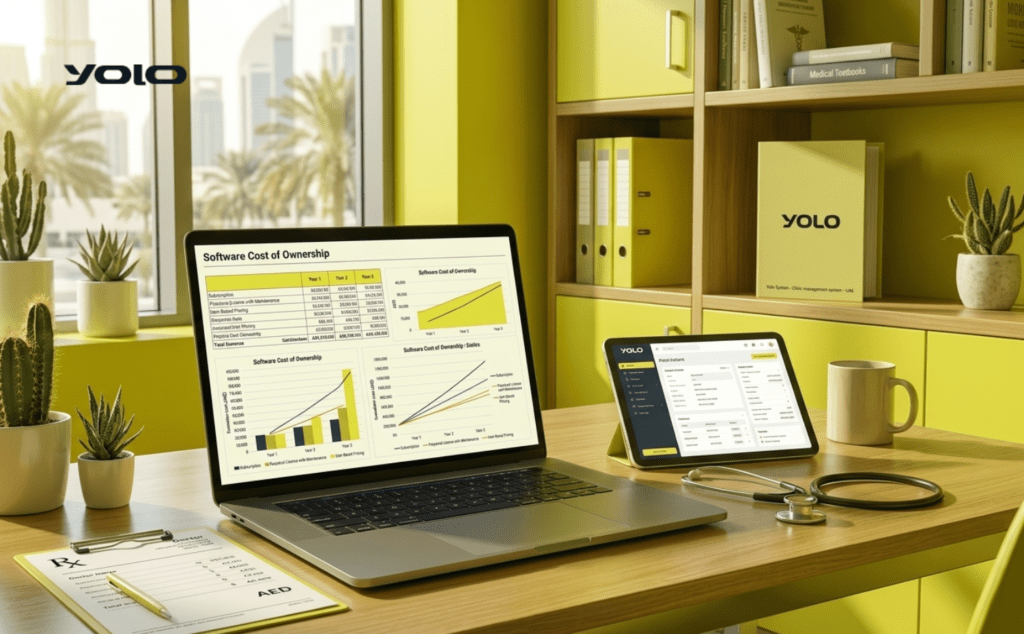
Dental software pricing UAE buyers see on a website rarely matches the invoice. Total cost of ownership across three years includes implementation, migration, messaging credits, and add-on modules that the headline rate excludes.
Per-provider vs. per-location vs. quote-based pricing
Three pricing structures dominate, and each scales differently.
| Model | Scales with | Best fit |
| Per provider | Number of dentists | Single clinics with stable headcount |
| Per location | Number of branches | Groups with multiple providers per site |
| Quote-based | Negotiated | Larger groups with mixed requirements |
Per-provider pricing penalises clinics that add associates. Per-location pricing penalises single-dentist practices with several small sites.
Model your own growth plan against both before comparing headline rates.
Hidden costs: implementation, migration, messaging credits, and add-on modules
Hidden costs surface in the second quarter, after budgets are set. Yolo removes two of the largest at the start: free migration from any other system, and no hardware requirement.
Budget for these line items:
- Implementation and configuration fees
- Data migration, including imaging archives
- WhatsApp and SMS credits beyond the bundled allowance
- Add-on modules for inventory, payroll, or accounting
- Training sessions beyond the included package
- Storage overage on imaging files
Full-stack coverage changes this list materially. Yolo bundles HR, inventory, accounting, and profitability reporting inside the platform, so those functions do not arrive as separate subscriptions.
A worked TCO example: 3-chair clinic vs. 5-branch group in AED
Three-year TCO exposes what monthly pricing conceals. Build the comparison on this structure.
For a 3-chair single clinic:
- Subscription across 36 months
- One-time implementation and migration
- Annual messaging credit overage
- Training for four staff members
For a 5-branch group, add:
- Per-location subscription multiplied across sites
- Staggered implementation cost per branch
- Group-level reporting or add-on module fees
- Additional HIE connectivity requirements across emirates
The group comparison shifts outcomes. A platform priced higher per month often lands lower across three years by bundling modules that others charge separately.
Run the total in AED, not in the vendor’s home currency, and account for the exchange rate.
How to stress-test a vendor’s ROI study before believing it
ROI studies commissioned by vendors model composite customers rather than real ones. Treat the headline percentage as marketing until it survives three checks.
- Identify who funded and commissioned the study
- Confirm whether the modelled practice matches your size and specialty mix
- Request a reference customer in your segment and your market
Cancel-anytime terms carry more weight than any ROI projection. Yolo sells without a lock-in period, which shifts the risk of a wrong decision away from the clinic.
Cost sets the constraint. Practice profile sets the requirement.
Choosing by Practice Profile
Requirements for dental cloud practice management software shift with practice size and structure. A solo dentist and a five-branch group need different architectures, not different price tiers of the same product.
Solo practitioner and single-chair clinics
Solo practices need scheduling, charting, claims, and reminders working reliably from day one. Complexity is the enemy.
Priorities in order:
- Simple daily workflow with minimal clicks
- eClaimLink submission built in
- Automated reminders to protect a single-chair schedule
- Cancel-anytime terms without multi-year lock-in
One no-show in a single-chair clinic removes an hour of capacity that cannot be recovered.
2 to 5 chair private clinics in Dubai and Abu Dhabi
Multi-chair clinics add provider coordination and inventory control to the requirement list. Cloud dental software Dubai buyers should confirm NABIDH connectivity first, while Abu Dhabi practices confirm Malaffi.
Operational needs expand:
- Chair utilisation reporting across providers
- Inventory of medical consumables with auto-reordering
- Staff time tracking, leave, digital employee file, and payroll
- Treatment profitability by provider
Yolo covers all four inside one subscription, including automatic reordering from suppliers when consumable stock drops.
Consumable stockouts stop clinical work. Inventory automation is not an optional module at this size.
Multi-branch groups across emirates
Multi-branch dental clinic software must deliver one patient record and one reporting layer across all sites. Groups operating in Dubai and the Northern Emirates need coverage across NABIDH and Riayati simultaneously.
Non-negotiable requirements:
- Single centralised database, not synced copies
- Cross-location reporting in real time
- HIE coverage matching every emirate you operate in
- Role permissions scoped by branch
A group running two platforms runs two sets of numbers. Yolo’s coverage of all three exchanges lets a group standardise on one system across every emirate.
Multi-specialty centres with a dental department
Polyclinics running dermatology, physiotherapy, and dentistry together gain from one system covering all departments. Separate dental software creates a second patient database and a second reporting silo.
This is Yolo’s core profile. The platform was built as a clinic management system across specialties rather than a dental-only product, so a dental department shares the same EMR, calendar, inventory, and accounting layer as every other department in the centre.
Full-stack coverage matters more here than dental-specific depth.
Clinics serving dental-tourism and international patients
International patient workflows need multilingual communication, self-pay billing, and treatment plans that travel. Patient records must export cleanly for continuing care abroad.
Bilingual invoicing and remote treatment plan sharing carry more weight than domestic insurance depth in this segment.
Profile determines the shortlist. Contract terms determine whether you can ever leave it.
Data Ownership, Export Rights, and Avoiding Vendor Lock-In
Data ownership is the clause that decides your switching cost five years from now. Vendor lock-in in dental cloud practice management software happens through export restrictions, not through contract length.
The four export questions to put in the contract
Verbal assurances about data access carry no weight at termination. Put four answers in writing.
- Which file formats do patient records and clinical notes export in?
- Do images export as standard DICOM files?
- Is there a fee to perform a full data export?
- What is the guaranteed delivery time for the complete dataset after notice?
A vendor refusing to contract these four points has given you the answer.
Standard formats: CSV, XML, and DICOM for imaging
Export format determines whether your data is portable or merely retrievable. A proprietary format is a locked box with a window.
Acceptable standards:
| Data type | Required format |
| Patient demographics | CSV or XLSX |
| Clinical notes | CSV, XML, or structured PDF |
| Imaging | DICOM |
| Financial records | CSV with transaction detail |
DICOM export for imaging is the clause most buyers forget. Radiographs trapped in a proprietary viewer cannot move to a new platform.
Exit fees, notice periods, and dataset delivery timelines
Exit terms sit in the contract sections nobody reads at signing. Yolo’s cancel-anytime model removes the lock-in period, though every buyer should still confirm that the export obligation survives cancellation.
Check three clauses:
- Notice period required before termination
- Any fee attached to data extraction
- Vendor obligation to maintain access during the transition window
Thirty days of overlapping access makes a migration survivable. Zero overlap makes it chaos.
Export rights protect the exit. Planning protects the entry.
Migration Planning: Where Implementations Actually Fail
Migration failures in dental cloud practice management software rollouts trace to three causes: compressed timelines, unconverted imaging archives, and untrained staff. Software selection consumes months while migration planning gets two weeks.
Realistic timelines per location and staggered rollouts
Per-location implementation runs on a defined schedule that acquiring groups routinely underestimate. Sequential rollouts outperform simultaneous switches.
Sequence the work:
- Migrate the smallest branch first as a controlled test
- Document every issue and its fix
- Apply the corrected process to the second location
- Scale across remaining sites with a proven playbook
The first branch teaches you what the vendor’s documentation did not.
Legacy data conversion, imaging archives, and manual-import gaps
Imaging archives break more migrations than clinical records do. High-resolution radiographs and CBCT volumes frequently require manual import outside the automated conversion.
Establish before go-live:
- Which data converts automatically
- Which requires manual handling and who performs it
- How many years of imaging history transfer
- Where legacy data lives if it does not migrate
Yolo provides free migration from any other system, which removes the cost. Scoping the imaging archive remains the clinic’s job.
Sandbox validation before go-live
Sandbox environments let you test with real data before committing. Request one and use it properly.
Validate five workflows end to end:
- Register a patient and capture Emirates ID
- Chart a full periodontal exam
- Submit a claim through eClaimLink
- Generate a bilingual invoice with correct VAT treatment
- Run a cross-branch revenue report
A sandbox that only demonstrates the interface has not validated anything.
Staff training and the first 30 days
Front-desk staff determine whether a migration succeeds. They enter the data every other function depends on.
Structure the first month:
- Train receptionists on registration and scheduling before go-live
- Run parallel systems for the first week where practical
- Assign one internal champion per branch
- Schedule a review at day 30 to correct workflow drift
Support responsiveness matters most in exactly this window. Yolo backs its platform with a 24-hour guaranteed support commitment or your money back, which is the kind of term worth reading in full before signing.
Training closes the implementation. Questions close the purchase.
The Vendor Demo Script: 15 Questions to Ask Before Signing
Vendor demos showcase strengths and route around gaps. These 15 questions force specific answers about dental cloud practice management software before money changes hands.
Compliance and residency questions
- Which health information exchanges do you connect to: NABIDH, Malaffi, Riayati, or all three?
- In which country do production servers and backups physically sit?
- How does the platform handle UAE PDPL requirements for access logging and audit trails?
- Which security certifications do you hold, and can you send the certificates?
- How do you handle record retention requirements set by DHA, DoH, and MOHAP?
Question one filters the shortlist faster than any other.
Integration and interoperability questions
- Which intraoral sensors, OPG units, and CBCT systems do you bridge to, by make and model?
- Does claim submission run directly through eClaimLink, or through a third party?
- Do you offer a public API, and what does it expose?
- How does the Arabic interface handle RTL rendering across every module?
- Does Emirates ID scanning auto-populate patient registration fields?
Ask for a live demonstration of each integration on your own equipment list.
Commercial and contractual questions
- What is the total cost across 36 months, including implementation and migration?
- Which modules cost extra, and what are those rates in AED?
- What is the notice period, and is there any fee to export my data?
- Can you provide a reference customer of my size in the UAE?
- What is your guaranteed support response time, and what happens if you miss it?
Vendors answering all 15 without deflection have earned the shortlist. Clinics ready to run this script against a full-stack platform can book a demo with the Yolo team through the demo form or the UAE WhatsApp line.
Questions expose gaps. Assumptions create them.
Run every chair, branch, and claim from one system
Appointments, records, charting, billing, and reporting in one platform, with native NABIDH, Malaffi, and Riayati integration across all seven emirates.
Common Buyer Mistakes and Vendor Myths
Buyers evaluating dental cloud practice management software repeat three errors: trusting foreign compliance badges, misreading product families, and comparing feature lists instead of architecture. Each one costs money after signing, not before.
Assuming HIPAA compliance satisfies UAE requirements
HIPAA governs US healthcare privacy and carries no authority in the Emirates. A HIPAA-compliant platform without NABIDH, Malaffi, or Riayati connectivity cannot support your licence renewal.
GDPR sits in the same category. European data protection alignment is useful evidence of security maturity and irrelevant to UAE health regulation.
Check the exchange list first. Check the badges second.
Confusing product families and ownership structures
Software brands sell several products under one name, with different architectures behind each. The cloud version and the server version of the same brand behave nothing alike.
Confirm three details in writing:
- The exact product name and edition you are buying
- Whether that specific edition centralises data across locations
- Whether the UAE compliance features apply to your edition
A group buying the wrong edition ends up with a separate database in every branch.
Buying on feature lists instead of operating architecture
Feature lists compare well on paper and predict nothing about daily operation. Two platforms listing “multi-location support” can mean centralised data or synced copies.
Evaluate on four structural questions:
- Does one patient exist once across all branches?
- Does group reporting run live or through export?
- Which HIE exchanges are covered natively?
- What does the data export clause guarantee?
Architecture answers survive the sales cycle. Feature lists do not.
Frequently Asked Questions
What is dental cloud practice management software?
Dental cloud practice management software manages patient records, scheduling, clinical charting, imaging, billing, and reporting through a browser-based platform hosted by the vendor. No local server, no on-site IT maintenance.
What is the difference between cloud-based and server-based dental software?
Cloud systems centralise data across all locations and update automatically. Server-based systems place a separate database in each office, creating isolated records and manual group reporting.
Is cloud dental software compliant with DHA and MOHAP regulations?
Compliance depends on health information exchange connectivity. Platforms integrated with NABIDH, Malaffi, and Riayati, including Yolo, support your licensing path across Dubai, Abu Dhabi, and the Northern Emirates.
Can dental software submit insurance claims through eClaimLink?
Platforms with direct eClaimLink integration submit claims, request pre-authorization, and process remittance inside the clinical workflow. Dubai directive PD-05-2025 mandates end-to-end electronic claims.
Does dental practice management software support Arabic and Emirates ID?
Bilingual platforms provide full RTL Arabic interfaces, dual-language patient communication, and Emirates ID scanning that populates registration fields automatically. Yolo operates in both English and Arabic.
Should a dental clinic use dental-specific software or a general clinic management system?
Single-specialty dental practices with heavy imaging benefit from dental-specific depth. Multi-specialty centres with a dental department gain more from a unified clinic management system such as Yolo, covering every department in one database.
How is 5% VAT applied to dental treatment invoices?
FTA VAT applies at 5% on applicable services, with cosmetic and medically necessary treatment carrying different treatment. The invoicing module must apply the correct rate per service line.
What should I demand in writing about exporting my data before signing?
Four answers: export file formats, DICOM availability for imaging, any extraction fee, and the guaranteed delivery timeline for your complete dataset after notice.
Making the Decision
Dental cloud practice management software selection in the UAE turns on four verifiable points rather than on feature counts. Confirm health information exchange coverage across NABIDH, Malaffi, and Riayati for every emirate you operate in. Confirm eClaimLink connectivity for the claim cycle. Confirm data residency, audit trails, and export rights in the contract. Confirm total cost across 36 months in AED, not the monthly headline.
Yolo answers all four from one platform: native integration with all three exchanges, ISO-certified information security management, bilingual Arabic and English operation, free migration from any other system, cancel-anytime terms, and a 24-hour guaranteed support commitment. The German-engineered platform covers dental practices as part of a full clinic management system spanning EMR, scheduling, billing, HR, inventory, accounting, and profitability reporting.
Run the 15-question demo script. Test in a sandbox with your own data. Then request your copy through the demo form or the UAE WhatsApp line.
Technical Reviewer for Medical Management Systems & Digital Transformation Consultant for Clinics