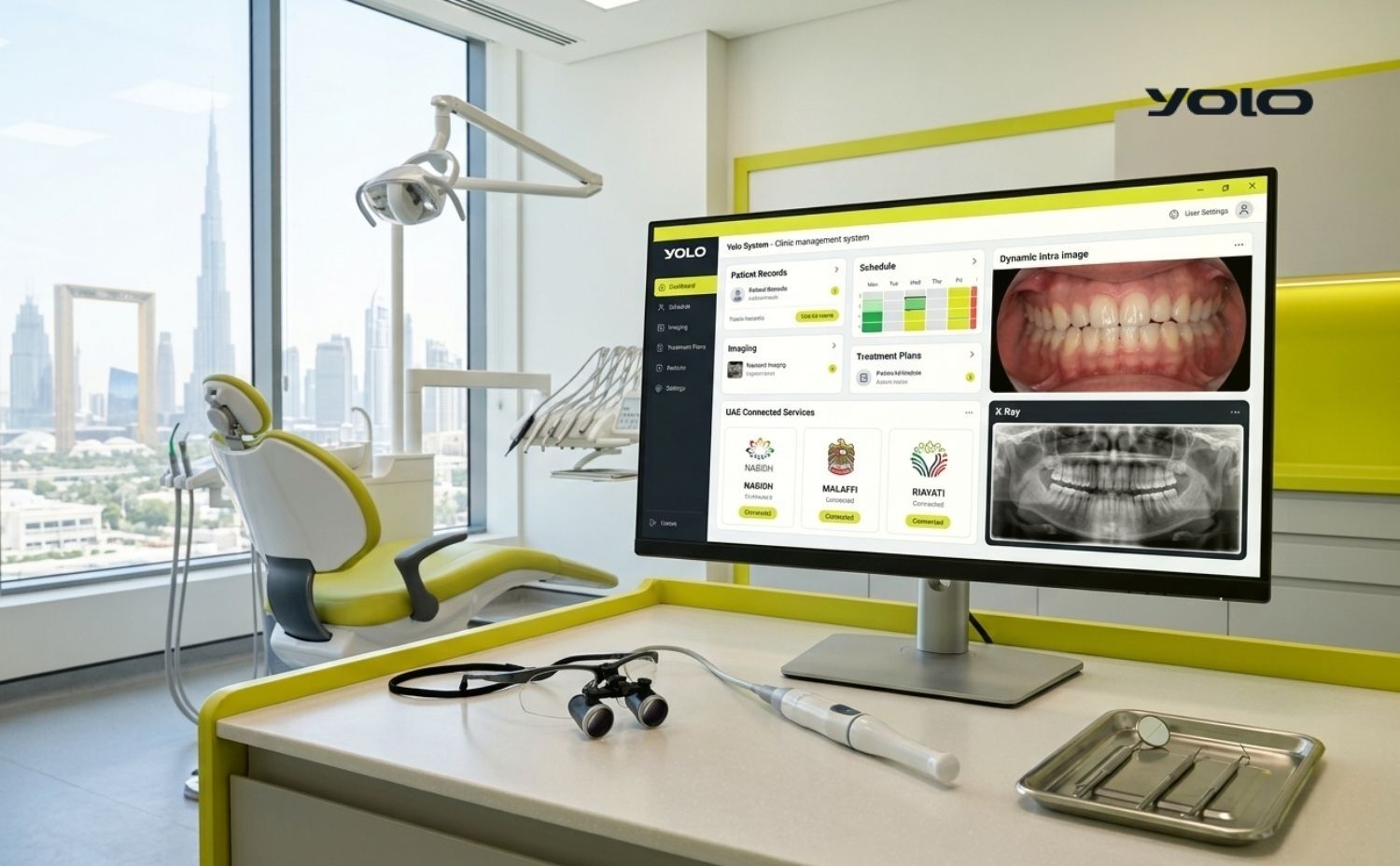
All-in-one dental practice management software runs a dental clinic’s records, schedule, billing, staff, and stock from a single database instead of five disconnected tools. UAE clinics carry one extra requirement that changes the entire shortlist: health information exchange integration, which is a licensing matter rather than a feature. Dubai clinics connect through NABIDH, Abu Dhabi clinics through Malaffi, and Northern Emirates clinics through Riayati. This guide breaks down every buying criterion that applies inside the UAE, in the order a clinic owner actually meets them.
What All-in-One Dental Practice Management Software Actually Includes
All-in-one dental practice management software combines four operational layers in one database: front office, clinical, revenue cycle, and management. Anything missing a layer is a partial system sold under a full-system label.
The Four Operational Layers: Front Office, Clinical, Revenue Cycle, and Management
Practice management software starts as an operational spine, not a records cabinet. Each layer owns a different part of the clinic’s day, and each one feeds the next. Because each layer depends on the one before it, what is a clinic management system becomes a question of architecture rather than feature count: which layers the database owns, and how cleanly it hands records to the next one.
| Layer | What it owns | Failure cost when it is missing |
| Front office | Booking, reminders, intake, check-in, patient identity via Emirates ID | Empty chairs and no-shows |
| Clinical | EHR/EMR, dental charting, treatment planning, prescriptions, imaging access | Rework, weak case acceptance |
| Revenue cycle | Pricing, invoicing, insurance claims, collections | Delayed cash, rejected claims |
| Management | Staff, inventory, accounting, profitability reporting | Invisible cost leaks |
The fourth layer separates real platforms from bare records systems. Most vendors stop at three.
Yolo builds all four into one system, including EMR, AI-optimized scheduling, staff payroll and role management, consumables inventory with automatic reordering, accounting, and a treatment pricing calculator that shows profit per procedure. Clinic owners can review the full module list of a clinic management platform before comparing anything else.
What “All-In-One” Quietly Excludes: Imaging AI, Clearinghouses, and Tiered Add-Ons
Three product categories get sold as practice management systems while depending on one. Radiograph AI tools read images and flag findings. Claims clearinghouses transmit transactions. Neither one schedules a patient, charts a tooth, or closes a month.
Read the exclusions before the feature list:
- Radiograph AI analysis, which enriches diagnosis but stores nothing
- Clearinghouse transmission, which moves claims but owns no patient record
- Patient messaging sold per channel, where SMS, email, and WhatsApp each carry a separate line item
- Analytics dashboards priced as a premium tier above the base licence
A “basic” plan often costs more by month twelve. Each bolt-on adds a login, a support contact, and a data sync that breaks quietly.
All-In-One Versus a Modular Stack, and Where Fragmentation Costs Money
Fragmentation charges a clinic twice: once in licence fees, once in staff minutes. A receptionist who copies a phone number from a booking tool into a billing tool performs data entry that a single database eliminates.
Modular stacks make sense in one scenario only: a clinic with an existing clinical system it cannot replace, wrapping operations around it. Every other clinic pays a coordination tax for the privilege of choosing best-in-class tools that never fully speak to each other.
Compliance is where fragmentation becomes expensive rather than annoying.
Why UAE Clinics Must Evaluate Practice Management Software Differently
UAE dental clinics answer to three separate licensing authorities and three separate health information exchanges, depending on the emirate. Practice management software that ignores this architecture blocks a licence renewal, regardless of how strong its clinical tools are.
DHA, DoH, and MOHAP Licensing Expectations by Emirate
Regulatory ownership splits geographically across the seven emirates. DHA (Dubai Health Authority) licenses facilities in Dubai. DoH Abu Dhabi (Department of Health) governs Abu Dhabi and Al Ain. MOHAP (Ministry of Health and Prevention) licenses the Northern Emirates, including Sharjah, Ajman, Umm Al Quwain, Ras Al Khaimah, and Fujairah.
Each authority sets its own submission format, its own timelines, and its own audit expectations. A dental clinic in Sharjah and a dental clinic in Deira follow different rulebooks with the same patient population.
NABIDH, Malaffi, and Riayati: Which Exchange Applies to Your Clinic
Health information exchange integration reaches the clinic through its EMR vendor, never through the clinic itself. Data moves over HL7 v2.5.1, with FHIR R4 applied to newer work, and all three platforms interlink under the National Unified Medical Record.
| Exchange | Authority | Coverage |
| NABIDH | DHA | Dubai |
| Malaffi | DoH Abu Dhabi | Abu Dhabi and Al Ain |
| Riayati | MOHAP | Northern Emirates |
Single-exchange coverage is the market norm, and it is the single most expensive gap a growing group discovers late. A clinic that opens a second branch across an emirate border with a one-exchange vendor faces a second integration project, a second vendor negotiation, or a migration.
Yolo covers NABIDH, Malaffi, and Riayati natively in one system. A multi-branch group keeps every location on the same licence renewal path, whether it operates in Dubai, Abu Dhabi, or the Northern Emirates.
That is the deciding line for most buyers.
Data Residency and Record Retention Obligations
Data residency determines where patient records physically sit, and UAE health data rules treat hosting location as a licensing condition rather than a technical preference. Encryption, access roles, and audit trails belong in the same conversation.
Ask any vendor four questions:
- In which country does the production database sit?
- Who inside the vendor can read a patient record, and what logs that access?
- How long are records retained, and does the archive meet the licensing authority’s retention period?
- What proves the security claim beyond a marketing page?
Yolo answers the last one with independently certified information security management, holding ISO certification for both quality and information security management systems.
Bilingual Arabic and English Records, RTL Interfaces, and Patient Name Handling
Bilingual operation functions as a hard requirement in UAE dental practice, not a localisation bonus. Patient records, invoices, and reminders all need Arabic and English, and the interface needs genuine right-to-left support rather than a translated menu.
Name handling breaks weak systems fast. Arabic naming conventions, transliteration variants, and Emirates ID matching all have to resolve to one patient file, or the same person appears three times in the database.
Yolo runs bilingual English and Arabic across the web app and the iOS, Android, and Huawei apps.
The Core Feature Set: What All-In-One Dental Practice Management Software Must Do
All-in-one dental practice management software earns its label through six functional blocks. Charting integrity sits at the centre, because a system without graphical dental charting manages a business rather than a dental practice.
Scheduling, Recall, Waitlists, and No-Show Reduction
Scheduling drives revenue more directly than any other module. An unfilled chair hour costs the full hourly production of that operatory, and recall lists decide how many hours stay filled next quarter.
Requirements worth testing in a demo:
- Online booking that writes straight into the live calendar
- Automated confirmations and reminders across WhatsApp, SMS, email, and push
- Waitlist logic that fills a cancellation without a phone call
- Recall scheduling tied to hygiene intervals
Yolo automates confirmations and reminders across all four channels and optimizes calendar slots with AI, which attacks no-shows at the point where they form.
Graphical Dental Charting and Perio Charting: The Integrity Test
Dental charting distinguishes dental practice management software from general clinic software. A graphical odontogram records surfaces, restorations, and findings per tooth, and perio charting records pocket depths, recession, bleeding points, and furcation grades over time.
Verify this module directly in the demo. Ask the vendor to chart a tooth, then chart a full-mouth perio series, then show the comparison against the previous exam.
Treatment Planning and Chairside Case Presentation
Treatment planning converts diagnosis into accepted revenue. A plan that pulls images, findings, and insurance coverage into one screen raises case acceptance, because the patient sees the clinical reason and the cost together.
Phased plans matter for high-value dentistry. Implants, orthodontics, and full-mouth rehabilitation run across months and need staged pricing the front desk can quote without a recalculation.
Imaging: 2D Radiography, 3D CBCT, and Intraoral Capture
Imaging integration protects existing hardware investment. Sensors, intraoral cameras, panoramic units, and CBCT scanners should attach to the record without a forced hardware swap.
Confirm your specific sensor models during migration planning. Model compatibility varies inside the same brand.
Prescriptions, Structured Clinical Notes, and Medical Alerts
Clinical documentation carries medico-legal weight. Structured notes with templates cut charting time, while medical alerts surface allergies, anticoagulant use, and chronic conditions before an injection rather than after.
Yolo’s EMR holds visit history, documents, and vital signs in one patient file, retrievable by name, mobile number, or medical record number.
Inventory, Lab Work Tracking, and Expense Management
Inventory control returns money quietly. Composite, anaesthetic, burs, and impression material expire on shelves, and lab cases sit in transit without an owner until a patient calls.
Yolo tracks consumables in real time, triggers automatic reordering from suppliers, and links expenses to the accounting module so cost per treatment stays visible.
Costs only become controllable once the revenue side is equally visible.
Insurance and Revenue Cycle Under UAE Rules
Revenue cycle management in the UAE follows emirate-specific claim rails, and health insurance became mandatory across all seven emirates from 1 January 2025. Patient volume and claim load both rose inside private clinics as a direct result.
eClaimLink, Shafafiya, and DHPO Submission Workflows
Claim transmission runs on regulated platforms rather than vendor portals. eClaimLink carries Dubai claims under DHA, DHPO (Dubai Health Post Office) acts as the transaction hub for those submissions, and Shafafiya carries Abu Dhabi claims data under DoH.
Dubai directive PD-05-2025 mandates end-to-end electronic claims through eClaimLink, with fixed pre-authorization and payment timelines. Paper workarounds no longer exist as a fallback.
Ask every vendor to demonstrate the exact claim path from treatment completion to submission. A billing module is not a claims pipeline, and the two get marketed with the same vocabulary.
Pre-Approvals, Eligibility Checks, and Coding
Coding accuracy decides rejection rates. Dental claims run on CDT procedure codes alongside ICD diagnosis codes, with CPT applied to surgical work, and a mismatch between the three triggers a denial weeks after treatment.
Pre-approval workflow deserves equal attention:
- Eligibility verification before the appointment, not at checkout
- Coverage limits and EBP (Essential Benefits Plan) rules visible to the front desk
- Pre-authorization tracking with the timelines PD-05-2025 fixes
- Denial reasons logged against the original claim
VAT-Compliant Invoicing and E-Invoicing Readiness
Invoicing carries a tax obligation on top of a clinical one. Dental services fall under UAE VAT rules in most cases, and the FTA e-invoicing programme is being phased in for structured electronic invoices exchanged in a mandated format.
Readiness costs nothing today and saves a migration later. Ask whether the vendor’s invoice engine can output structured formats rather than PDFs.
Collections, Instalment Plans, and Text-to-Pay
Patient collections decide cash flow in dentistry, where the patient portion often exceeds the insured portion. High-value plans stall at the payment conversation, not the clinical one.
Yolo handles patient-side money through vouchers and a patient wallet, alongside invoicing and real-time financial reporting, so outstanding balances stay visible per patient instead of per month.
Where all this data lives determines how fast any of it moves.
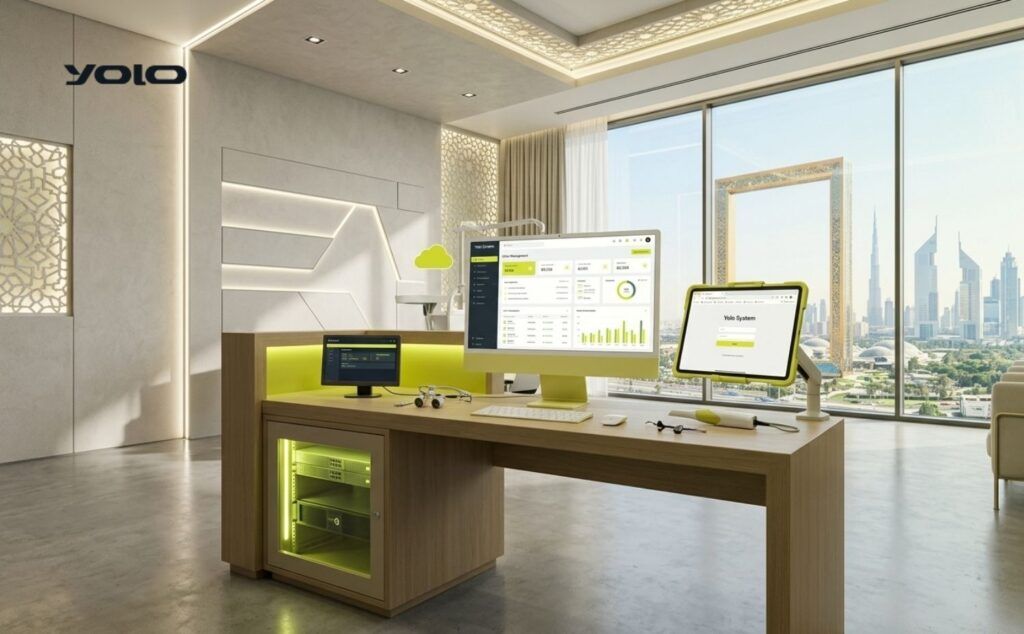
Deployment Models for All-In-One Dental Practice Management Software: Cloud, On-Premise, and Browser-Based
All-in-one dental practice management software ships in three deployment shapes, and the choice sets your IT burden for the next five years. Cloud shifts maintenance to the vendor, on-premise keeps it in the clinic.
Cloud Hosting: Updates, Backups, and Multi-Site Access
Cloud deployment removes the server from the clinic and the backup task from the manager’s week. Understanding how cloud dental practice management works day to day in a UAE clinic clarifies what changes operationally after the switch.
Cloud advantages that hold up in practice:
- Vendor-managed updates, with no version-upgrade project
- Automated backups, verified without staff involvement
- Access from any device on web, iOS, Android, or Huawei
- Standardised protocols and unified reporting across locations
Yolo runs cloud-native with no hardware requirement, cancel-anytime terms, and free migration from any previous system.
On-Premise and Client-Server Operation Over a Local Network
On-premise deployment keeps the database on a local server, reachable across the clinic LAN. Full control comes bundled with full responsibility: patching, backup verification, hardware replacement, and after-hours failures.
Older client-server products install on every workstation. Browser-based local deployment installs once on the main machine, which cuts the long-term administration load.
Connectivity Reliability, Offline Fallback, and Chairside Continuity
Connectivity becomes clinical the moment a chart fails to load with a patient in the chair. Business-grade internet with a secondary line is the correct baseline for any cloud system in the UAE.
Ask the direct question: what happens chairside during a 20-minute outage?
Reliable access matters most for the workflows patients actually see.
Patient Communication and Retention Capabilities
Patient communication drives retention economics in dentistry, where recall compliance and reactivation cost a fraction of new patient acquisition. Automation decides whether either one happens consistently.
Automated Reminders, Online Booking, and Digital Intake Forms
Reminder automation delivers the fastest measurable return of any module, and WhatsApp outperforms SMS across the UAE patient base. Confirmation, reminder, and reactivation messages each play a different role in the schedule.
Some AI-driven clinic management platforms built for the region bundle WhatsApp, SMS, email, and push messaging with digital patient onboarding and a patient app, rather than pricing each channel as a separate module. Yolo takes that approach, with segmentation and automated remarketing layered on top.
Digital intake removes clipboard time from the waiting room. Forms completed before arrival populate the record directly, with no transcription step.
WhatsApp Business API: Consent, Templates, and Compliance
WhatsApp messaging operates under platform rules, not clinic preference. Template approval, opt-in consent, and message categories all govern what a clinic can send and when.
Patient consent records belong in the patient file. A reminder sent without documented opt-in creates a compliance question that no open rate offsets.
Patient Portals, Reviews, and Reputation Tools
Patient satisfaction becomes measurable through structured feedback rather than impressions. NPS tracking scores the clinic experience continuously and flags the specific visits that damaged it.
Yolo tracks NPS natively and feeds patient segmentation, so a follow-up campaign targets the group that needs it instead of the entire database.
3D Charting and VR Case Presentation: When the Cost Is Justified
Visual case presentation raises acceptance on high-value treatment, and the investment logic follows case value. A practice built on hygiene and single restorations recovers the cost slowly.
Implant, orthodontic, and full-mouth rehabilitation practices sit at the other end of that spectrum. Higher case value, faster payback.
Scale changes the calculation on every one of these tools.
Scaling Across Branches and Emirates
Multi-branch dental groups need one database and one licensing path, not duplicated systems per location. Growth exposes architectural shortcuts that a single clinic never notices.
Single Database, Shared Records, and Role-Based Permissions
A shared database lets a patient book at any branch and lets a dentist work across locations under one credential. Role-based permissions keep that access proportionate, so a receptionist in Ajman never opens payroll in Dubai.
Yolo assigns rights per employee across every module, with a digital employee file, time tracking, leave management, and payroll in the same system.
Multi-Emirate Branches With Different Exchanges and Licensing Authorities
Cross-emirate expansion multiplies regulators, not just locations. A Dubai branch reports to DHA through NABIDH, an Abu Dhabi branch to DoH through Malaffi, and a Sharjah branch to MOHAP through Riayati.
One vendor covering all three exchanges collapses that complexity into a single contract. Yolo covers all three natively, which is what keeps a three-emirate group on one system as it grows.
Group and DSO-Level Reporting and KPI Dashboards
Group reporting turns branches into comparable units. Production per chair, collection rate, no-show percentage, and profit per treatment tell a manager which location needs attention this week.
Yolo’s real-time dashboard consolidates clinic results, and its treatment pricing calculator exposes cost and profit per procedure at group level. Consistency across locations depends on browser-based systems that scale across locations rather than per-site installations.
Specialty Workflows: Orthodontics, Endodontics, Periodontics, and Oral Surgery
Specialty dentistry needs specialty data. Orthodontic cases run on instalment contracts and long treatment arcs, endodontics tracks canal detail, periodontics depends on longitudinal perio data, and oral surgery documents vital signs and sedation.
Mixed-specialty polyclinics carry a further requirement: dental, dermatology, and physiotherapy records in one platform without three separate systems.
Every capability above eventually meets the same question: what does it cost?
The True Cost of Ownership for a UAE Dental Clinic
Total cost of ownership for all-in-one dental practice management software extends well past the monthly licence. Licensing model, implementation, hardware, and add-ons decide the five-year figure.
Licensing Models Compared
| Model | Charged per | Best fit | Risk |
| Per practitioner | Each dentist or hygienist | Small clinics, stable teams | Cost scales with every hire |
| Per location | Each branch or clinic | Larger single sites, groups | Overpriced for solo practice |
| Per chair | Each operatory | Fixed-capacity clinics | Penalises expansion |
The same headline price produces multiples of difference over five years. A four-dentist clinic on per-practitioner pricing pays four times what a per-location licence costs.
Implementation, Migration, Training, and Hardware
Setup costs hide in four places: data conversion, image migration, staff training, and hardware. Server-based systems add the server, its replacement cycle, and the IT contract that maintains it.
Yolo removes three of those lines: no hardware requirement, free migration from any previous system, and hands-on onboarding with end-user training included.
Add-On Modules That Turn “All-In-One” Into an Upsell Ladder
Add-on pricing converts a low entry price into an escalating bill. Messaging channels, analytics, e-prescribing, and extra users each carry their own line item in tiered models.
Request the full price list, including every module you would eventually need. Then compare totals, not entry prices.
Currency Exposure and AED Budgeting
Pricing quoted in US dollars pushes exchange risk onto a clinic budgeting in AED. Annual renewals then shift for reasons unrelated to the software.
Ask for AED pricing with the renewal term fixed in writing.
Indicative Price Bands in the UAE Market
Published pricing remains rare in this category, which itself signals negotiation room. Vendors quoting per practitioner per month in the region cluster around a three-figure AED range, while enterprise and multi-branch contracts move to custom quotes.
Cost only answers half the question. Fit answers the rest.
A Decision Framework for All-In-One Dental Practice Management Software by Clinic Type
Clinic size and structure determine which capabilities of all-in-one dental practice management software actually earn their cost. The same platform serves a solo dentist and a six-branch group differently.
Solo Practitioner
Solo practices need booking, records, reminders, charting, and clean invoicing. Payroll modules and group dashboards sit unused, so licensing model matters more than feature count.
Compliance still applies in full. One dentist in Dubai carries the same NABIDH obligation as a twelve-chair clinic.
Single-Location Clinic With Three to Six Chairs
Clinics at this size hit their limit on coordination, not clinical capability. Multiple dentists share a schedule, a stock room, and a front desk, which is where a single database starts paying for itself.
Reviewing how dental clinics already running on a general clinic management platform describe the change gives a realistic picture of what improves first. Scheduling and inventory control come up repeatedly.
Multi-Branch Group and DSO
Groups buy centralisation. Shared records, shared credentials, standardised templates, consolidated reporting, and one compliance path across emirates outweigh any individual feature.
Academic and Teaching Clinics
Teaching environments add supervision and assessment layers: student work approval, competency grading, and research reporting on top of standard clinical records.
When All-In-One Is the Wrong Answer
All-in-one fails in two situations. A clinic locked into a clinical system by an existing investment cannot rip out the centre of its workflow, and a highly specialised surgical practice sometimes needs depth that no broad platform matches.
Honest vendors say this out loud. Ask directly whether your case is one of them.
Vendor Evaluation: What to Test Before You Sign
Evaluating all-in-one dental practice management software means testing claims, not reading feature grids. Every vendor lists the same capabilities, so the demo is where the differences appear.
A Fifteen-Question Due Diligence Script for the Demo
Run these questions in order, and take notes in the demo itself:
- Chart a molar with three restorations, live.
- Record a full-mouth perio series, then show the previous exam beside it.
- Show a phased treatment plan with staged pricing.
- Which health information exchanges do you integrate with today?
- Show a claim moving from treatment to submission.
- Where does the production database physically sit?
- Which certifications cover your information security management?
- Show the Arabic interface and an Arabic invoice.
- Match one patient across two Emirates ID entry variants.
- Send a WhatsApp reminder from the live system.
- Show branch-level and group-level reports side by side.
- List every module that costs extra.
- Quote the price in AED, per practitioner and per location.
- Describe the migration process and who performs it.
- Export my full patient database in front of me.
How to Verify Exchange Integration Claims Rather Than Accept Them
Integration claims require evidence, because “compliant” and “integrated” carry different meanings. Interoperability here means live data exchange over HL7 v2.5.1 or FHIR R4, not a compatible file format.
Request three specifics:
- The named exchanges live in production today
- Reference clinics operating on each one
- Which party owns the onboarding work, vendor or clinic
Support: Local Presence, Language, Hours, and Escalation
Support quality surfaces during the first week, not the sales cycle. Time zones, Arabic-language capability, and escalation paths all determine how long a broken schedule stays broken.
Yolo backs its service with a 24-hour guaranteed support commitment or money back, and publishes a vendor FAQ covering support, migration, and data handling for the questions clinics ask before signing.
Data Ownership, Export Formats, and Exit Terms
Data ownership defines your leverage at renewal. A clinic that cannot export its own records in a usable format has no negotiating position and no exit.
Get export rights in the contract. Get the format named.
Signing is the start of the real project.
Migration and Go-Live: A 90-Day Plan
Migration determines whether a new system feels like an upgrade or a second job. Sequence matters more than speed, and a validated test environment prevents every expensive surprise.
Run the switch in four stages:
- Days 1 to 15: Data and image conversion into a test environment, with the clinic validating patient records, balances, and images before anything goes live.
- Days 16 to 30: Configuration of fee schedules, treatment codes, user roles, templates, and exchange integration.
- Days 31 to 45: Staff training by role, followed by parallel running on a limited patient set.
- Days 46 to 90: Go-live with support on standby, then weekly KPI review.
Migrating Paper and Legacy Records Under Retention Rules
Legacy records carry the same retention obligation as new ones. Paper charts and archived files need a documented path into the new system or a compliant archive, decided before cutover rather than after.
Staff Training, Adoption Resistance, and the Learning Curve
Adoption resistance follows a predictable curve. A long-serving receptionist works faster on the old system for the first two weeks, and that gap is the point at which most rollouts get abandoned.
Assign one internal owner per branch. Give the team a named person, not a helpdesk address.
Yolo’s onboarding team configures key workflows alongside clinic staff and trains end users directly, which shortens the resistance window.
The Metrics to Track in the First 90 Days
Track five numbers weekly: no-show rate, schedule utilisation, days to claim submission, collection rate, and production per chair. Movement in these five proves the system works better than any satisfaction survey.
Knowing what the market offers completes the picture.
Dental Practice Management Systems Used in the UAE Today
All-in-one dental practice management software in the UAE splits into four vendor categories, each with a predictable strength and a predictable gap. Category tells you more than a brand name does.
Regionally Built, Locally Compliant Platforms
Regional vendors lead on compliance and support proximity. Exchange integration, Arabic interfaces, AED pricing, and local onboarding come standard, while most cover a single exchange rather than all three.
Yolo sits in this category with an additional layer: German engineering under Yolo GmbH, native coverage of NABIDH, Malaffi, and Riayati, and full-stack clinic operations spanning HR, inventory, accounting, and profitability rather than a bare EMR.
Global Platforms and Their Localisation Gaps
International systems bring mature clinical depth and deep charting. Localisation is where they fall short: US-centric claim rails, no UAE exchange integration, dollar pricing, and support desks in another time zone.
Open-Source and Entry-Level Options
Open-source and low-cost systems suit tight budgets and technical owners. Configuration, hosting, updates, and compliance all become the clinic’s responsibility, which reintroduces the IT overhead the software appeared to remove.
The Criteria a Comparison Table Should Actually Contain
Feature checklists mislead because every vendor ticks every box. Score shortlisted systems on eight criteria instead:
| Criterion | What proves it |
| Exchange coverage | Named live integrations, reference clinics |
| Charting depth | Live odontogram and perio demo |
| Claim path | End-to-end submission demo |
| Data residency | Named hosting country, security certification |
| Bilingual operation | Arabic interface, Arabic invoice |
| Total cost | Full price list including add-ons, in AED |
| Support | Response commitment, language, escalation |
| Exit | Export format written into the contract |
Frequently Asked Questions
Common questions about all-in-one dental practice management software in the UAE, answered directly.
What is all-in-one dental practice management software?
All-in-one dental practice management software runs front office, clinical, revenue cycle, and management operations from one database, covering booking, EMR, dental charting, treatment planning, billing, inventory, staff, and reporting.
Is NABIDH integration mandatory for a dental clinic in Dubai?
NABIDH connectivity forms part of the licensing framework administered by DHA for Dubai health facilities, and integration reaches the clinic through its EMR vendor.
Which health information exchange applies outside Dubai?
Malaffi covers Abu Dhabi under DoH, and Riayati covers the Northern Emirates under MOHAP. All three interlink under the National Unified Medical Record.
Is cloud or on-premise better for a dental clinic?
Cloud fits clinics that want vendor-managed updates, automated backups, multi-location access, and no server. On-premise fits clinics with strict local-only requirements and in-house IT capacity.
How much does dental practice management software cost in the UAE?
Pricing depends on the licensing model, per practitioner, per location, or per chair, plus implementation, migration, training, and add-on modules. Request the full price list in AED.
Can dental claims be submitted through eClaimLink from the software?
Dubai requires electronic claims through eClaimLink under directive PD-05-2025. Ask each vendor to demonstrate the full submission path before signing.
Does the software need to support Arabic records and invoices?
Bilingual Arabic and English operation is expected across records, invoices, and patient messaging, with genuine right-to-left interface support.
Will I have to replace my sensors when switching systems?
Connection-friendly systems keep major sensors, intraoral cameras, and imaging units in place. Confirm your specific models during migration planning.
Can I export my data if I leave the vendor?
Export rights and file formats belong in the contract before signature, not in a support ticket afterwards.
How long do migration and training realistically take?
A structured switch runs about 90 days: two weeks of validated data conversion, two weeks of configuration, two weeks of training and parallel running, then go-live with weekly KPI review.
Does AI imaging replace a practice management system?
Radiograph AI analyses images and depends on a practice management system for patient data, documentation, and workflow. It replaces nothing.
Conclusion: Choosing the Right Platform
Selecting all-in-one dental practice management software in the UAE comes down to three tests: does it cover the health information exchange your licence depends on, does it chart dentistry properly, and does it show you the profit per treatment. Feature lists answer none of those. Demos do.
Yolo answers the compliance test with native NABIDH, Malaffi, and Riayati coverage in one system, and the operations test with EMR, AI scheduling, WhatsApp automation, staff management, inventory, accounting, and profitability reporting in the same platform.
Schedule a demo or message the UAE line on WhatsApp to see it against your own clinic workflow.
Technical Reviewer for Medical Management Systems & Digital Transformation Consultant for Clinics